
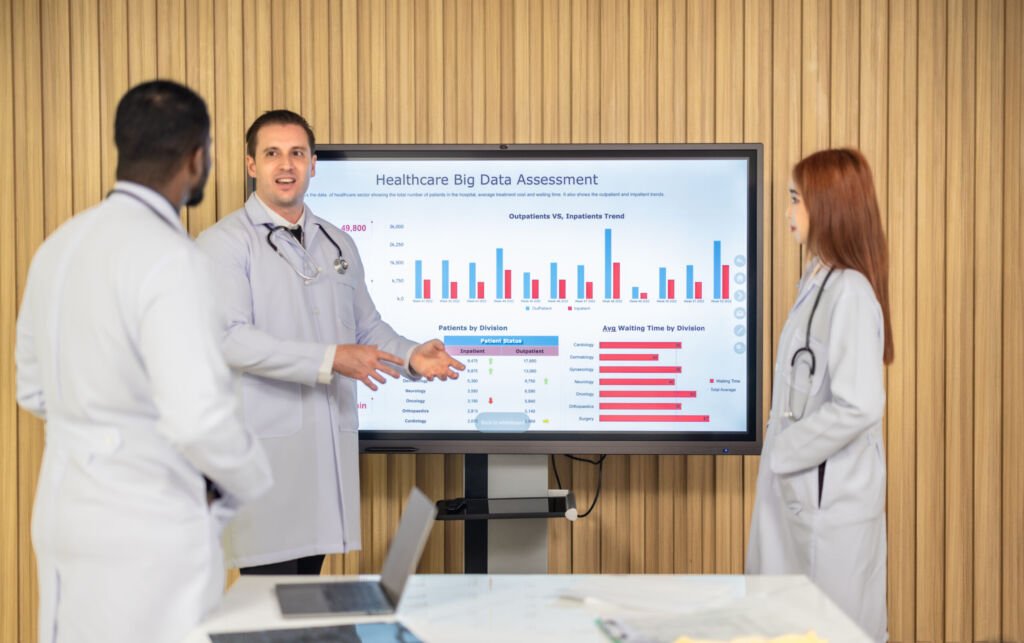
In 2026, healthcare leaders are asking better questions.
Not just, “How busy are we?”
Not just, “How many patients did we see?”
And definitely not, “Do the numbers look good on paper?”
The real question now is whether the numbers actually help people make better decisions. That is a big shift, and honestly, it is a necessary one. For a long time, a lot of organizations leaned on surface-level reporting. They tracked activity, reviewed totals, and built reports that looked polished in meetings but did not always help teams understand what was really happening. The numbers were there, but the insight was missing.
That is exactly why BEACON sees a bigger opportunity in 2026. The conversation is moving away from vanity metrics and toward operational clarity. Teams want data they can actually use. Leaders want visibility into what is slowing things down, where performance is improving, and what needs attention before a small issue turns into a bigger one.
That is where dashboards and smarter KPI strategy start to matter.
Vanity metrics are comforting, but they rarely move the work forward
It is easy to see why vanity metrics became so popular. They are clean, simple, and easy to present. Total visits, number of appointments, average volume, raw completion counts, broad utilization numbers. On the surface, they seem useful. But the problem is that they often stop at description.
They tell you what happened, but not always why it happened. They may show movement, but not whether that movement is good, sustainable, or meaningful. And in healthcare, that gap matters. A number can look impressive while the real experience behind it still feels fragmented, delayed, or unnecessarily difficult.
That is why teams are becoming more careful about performance measurement in healthcare. The goal is no longer just to collect data. The goal is to connect data to action.
For BEACON, that means asking better follow-up questions:
- What is this metric actually telling us?
- Does it reflect reality on the ground?
- Can a team use it to improve something specific?
- Does it help us understand flow, delays, quality, or outcomes?
- Is it measuring activity, or is it measuring progress?
Once organizations start thinking this way, reporting becomes a lot more useful.
The most valuable metrics help people make decisions faster
Good metrics do not just sit in a report waiting for someone to review them at the end of the month. They help people adjust sooner.
That is one of the biggest changes happening in 2026. Organizations are becoming less interested in static reporting and more interested in decision-support visibility. They want to know what is happening while there is still time to respond. They want insight that is practical, not just impressive.
This is where dashboards become more powerful than traditional reporting cycles. Instead of creating distance between the data and the decision, dashboards can bring them closer together. They help leaders, managers, and operational teams see patterns sooner, spot pressure points earlier, and align faster around what needs to happen next.
Still, that only works if the right things are being measured. A dashboard full of disconnected numbers is just noise with better formatting.
The strongest metrics are tied to outcomes, not ego
In healthcare, it is easy to get distracted by metrics that make performance look strong without actually proving that care delivery is improving. That is why outcome-based metrics matter so much right now.
They push teams to look beyond volume and into impact. They make it easier to ask whether a process is creating better follow-through, stronger patient flow, fewer avoidable delays, or better coordination across teams. They also help leaders connect operational performance to what patients and staff are actually experiencing.
This does not mean every metric needs to be clinical in nature. It means the metric should be connected to something that matters in the real world.
For BEACON, stronger measurement often comes from balancing questions like these:
- Are patients moving through the system more smoothly?
- Are handoffs happening with less friction?
- Are delays becoming less frequent?
- Are teams spending less time fixing preventable issues?
- Are decisions being made with better timing and clearer context?
Those are the kinds of questions that shift a team away from reporting for appearance and toward reporting for improvement.
The problem is rarely a lack of data
Most organizations do not have a data shortage. If anything, they have the opposite problem.
They have too much information, too many reports, too many disconnected numbers, and not enough clarity about which signals actually deserve attention. That is why many teams feel like they are measuring constantly while still struggling to see the full picture.
This is where well-defined healthcare indicators can create relief.
When the right indicators are selected carefully, teams stop chasing everything at once. They gain a clearer view of what deserves focus and what is simply background noise. Instead of reacting to every fluctuation, they can prioritize the signals that reveal meaningful trends in operations, coordination, access, and performance.
A useful indicator usually has a few qualities:
- it is easy to understand
- it connects to a specific operational reality
- it can be monitored consistently
- it supports a decision or next step
- it reflects something teams can influence
That last point matters. If a metric does not help people improve anything, it usually ends up becoming decorative.

Dashboards should simplify the story, not complicate it
A common mistake in healthcare reporting is assuming that more detail automatically creates more value. It usually does not.
When dashboards are overloaded, people stop engaging with them. They scan them quickly, miss the key takeaway, or ignore them entirely because the signal gets buried under too much information. In practice, the most effective dashboards are often the ones that make performance easier to read, not harder.
That is why BEACON should think carefully about how healthcare operational dashboards are designed.
A strong dashboard should help answer a few practical questions fast:
- Where are we doing well?
- Where is flow breaking down?
- What changed recently?
- What needs immediate attention?
- Who needs to respond?
If the dashboard cannot help clarify those points, it may be visually polished but strategically weak.
The best ones feel almost conversational. They guide the viewer toward understanding instead of making them work to decode the page.
Strategic tracking is about focus, not obsession
There is a difference between measuring performance and over-monitoring it. In some organizations, the push for accountability can turn into a kind of measurement overload where every task, every delay, and every variation gets tracked without enough context. That rarely creates clarity. More often, it creates fatigue.
That is why strategic performance tracking matters in 2026. The point is not to watch everything. The point is to watch the right things with enough consistency to support better judgment.
For BEACON, that usually means focusing on metrics that help teams:
- identify bottlenecks before they spread
- understand where coordination is weakening
- compare trends over time instead of reacting to isolated moments
- align operational priorities across departments
- make discussions more fact-based and less reactive
The best tracking systems support smarter conversations. They reduce guesswork. They help leaders move from assumptions to evidence. And they make performance reviews feel more grounded in reality.
Better KPI strategy helps teams connect quality with operations
One of the most useful things about better KPI design is that it helps organizations stop treating operational performance and care quality as separate conversations.
In reality, they influence each other all the time.
When operations are disorganized, quality becomes harder to protect consistently. When flow improves, teams often gain more time, more clarity, and more stability. When handoffs are cleaner and decision-making is faster, patients usually feel the difference, even if they never see the dashboard behind it.
That is why BEACON should treat KPI strategy as more than an executive exercise. It is a way to connect leadership priorities with frontline reality.
The metrics do not need to be flashy. They need to be useful.
And usefulness often comes from asking simple questions:
- Does this help us spot a problem sooner?
- Does this help us understand what is improving?
- Does this help a team respond with confidence?
- Does this support better communication across roles?
If the answer is yes, the metric is probably worth keeping.
What smarter decision-making looks like in 2026
In 2026, the organizations making the best use of data are not necessarily the ones with the biggest reporting stacks. They are the ones with the clearest measurement habits.
They know which numbers matter most. They review them consistently. They connect data to workflow, not just performance summaries. And they use dashboards to improve timing, visibility, and alignment across the organization.
For BEACON, a smarter approach to metrics usually includes:
- fewer vanity measures and more decision-ready signals
- simpler dashboards with clearer priorities
- metrics tied to real-world operational impact
- regular review rhythms that lead to action
- better alignment between leaders and teams
- stronger visibility into patterns, not just isolated snapshots
That kind of approach creates something every healthcare team needs more of: clarity under pressure.
Because at the end of the day, the value of a metric is not that it exists. The value is whether it helps someone make a better call at the right time.
Final Thoughts
In healthcare, data is only useful when it leads to better decisions.
That is why the shift beyond vanity metrics matters so much in 2026. Teams do not need more numbers just for the sake of reporting. They need visibility that helps them respond faster, prioritize better, and understand what is really happening across the organization. For BEACON, the opportunity is not just to track performance, but to build a smarter way of seeing it.